

Spectrum Control’s 2.92 mm (SMK) coaxial connectors provide precision RF connections from DC to 40 GHz. Available in male and female configurations, these connectors support broadband instruments, microwave cables, and test accessories where low insertion loss and controlled VSWR help preserve signal integrity.
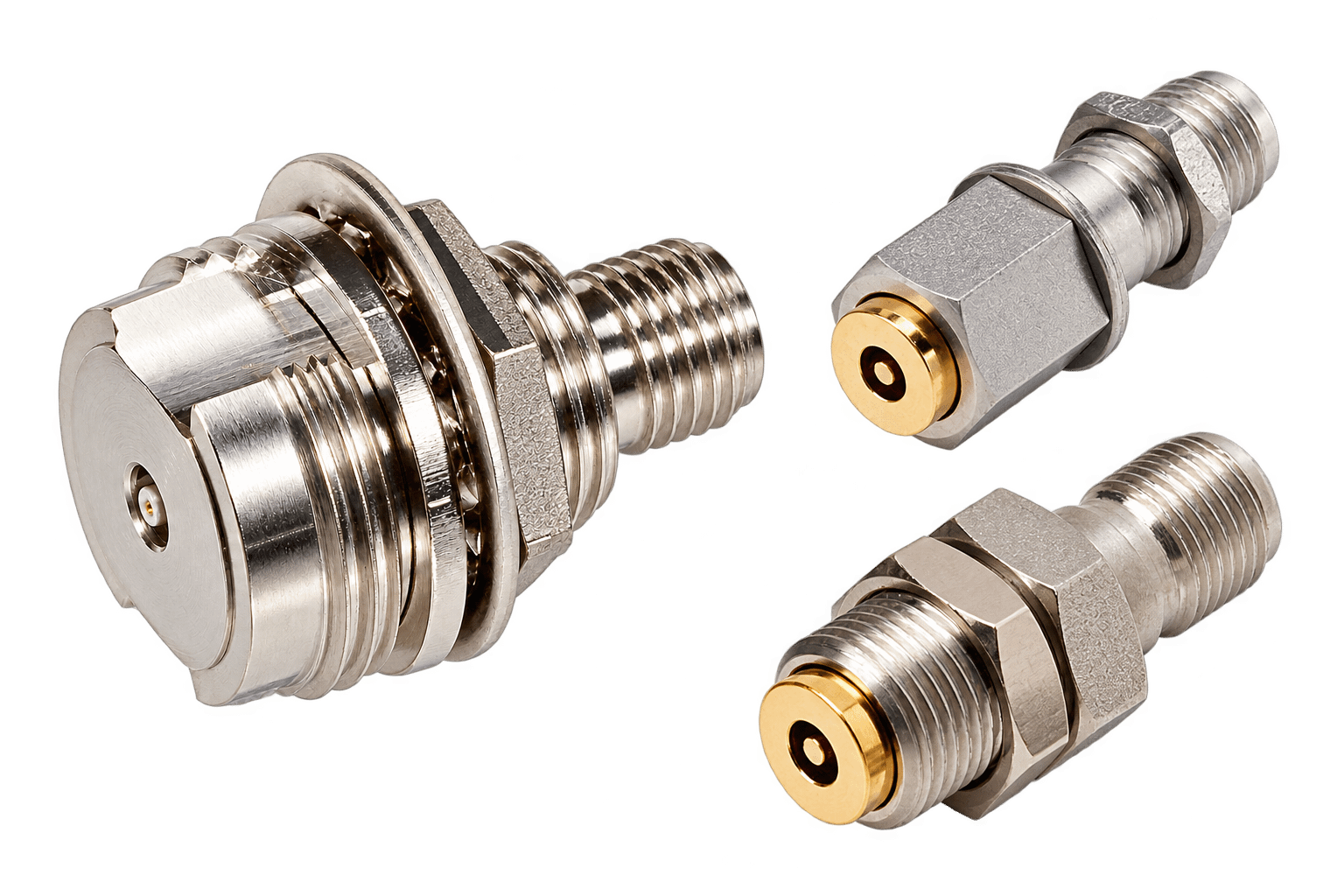
The Weinschel Planar Crown system combines a fixed bulkhead with a replaceable connector assembly. This design simplifies connector changes, reduces downtime from damaged interfaces, and accommodates different mating requirements without adding separate adapters.
How it Works
A coaxial signal path carries RF energy through a center conductor surrounded by an outer conductor. In crown-and-bulkhead designs, spring-loaded contacts maintain electrical contact, while interlocking features prevent rotation. A coupling nut secures the replaceable crown to the bulkhead.
Why it Matters
Frequent connection changes can wear instrument ports and interrupt testing. A replaceable crown makes servicing easier, while eliminating additional adapters helps limit connection loss and mismatch. This supports efficient testing and consistent RF performance.
Understanding the Interface
The 2.92 mm (SMK) interface mates with compatible SMA, 3.5 mm, and other 2.92 mm connectors. Mechanical compatibility does not guarantee the same frequency capability: select the complete connection for the required operating range, insertion loss, and VSWR.
2.92 mm (SMK) Connector Selection
Choosing Your Connector
Start with the connector’s role in your assembly: a fixed bulkhead, a replaceable crown, or a front- or rear-locking blind-mate design. When selecting, consider:
- Mating compatibility: Confirm that both halves are designed to work together.
-
Connector configuration: Choose the required male or female interface.
-
Mounting and access: Consider panel installation and access for connection or removal.
-
Electrical performance: Check frequency range, insertion loss, and VSWR for the complete mating pair.
Understanding Planar Connector Systems
Planar blind-mate connectors join complementary mating halves through a common planar interface. Available designs include crown-and-bulkhead systems and front- or rear-locking configurations. In crown-and-bulkhead systems, the removable crown allows the external connector interface to be replaced or changed while the bulkhead remains installed.
- Planar Blind Mate: A coaxial connector design that joins two mating halves through a common planar interface. The specific mounting, alignment, and retention features depend on the design.
- Planar Blind Mate Crown: The removable mating half, which provides the external coaxial connector interface. It allows the interface to be replaced or changed without replacing the fixed bulkhead.
- Planar Blind Mate Bulkhead: The fixed mating half, typically installed in a panel, instrument, or assembly. It provides the mounting base and planar interface for the crown.
-
Connection and Handling: The crown-to-bulkhead planar connection can be secured by hand without a torque wrench. Follow the applicable mating and torque requirements for the external coaxial connector.
Why This Design Matters
A replaceable crown makes it easier to service a worn connector or change the external connector interface while keeping the bulkhead installed. This flexibility is useful in instruments and test setups that require frequent connection changes.
Typical Applications
-
Vector network analyzer connections
-
Spectrum analyzer inputs
-
RF signal generator outputs
-
Microwave test cable assemblies
-
RF power measurement setups
-
Detector and SWR bridge interfaces
-
Broadband component characterization
Why Spectrum Control?
-
Broadband operation through 40 GHz
-
Low-loss, controlled-VSWR connections
-
Quickly replaceable connector crowns
-
Interchangeable connector types and genders
-
Secure, non-rotating planar interface
-
Stainless steel construction
-
Rugged female contact design