
PRODUCTS / COMPONENTS / FILTERS /
Highpass RF Filters
Low-insertion-loss highpass filters, with loss as low as 0.1 dB, are essential for defense platforms and modern wireless systems that require high spectral fidelity. Spectrum Control highpass filters reject unwanted low-frequency interference while preserving weak signals above the cutoff frequency. This helps receivers detect low-power targets, identify communications, and recognize valuable intelligence signals without sacrificing sensitivity in crowded spectrum environments.A high-pass filter is an RF filter that allows signals above a particular cutoff frequency to pass through while attenuating signals below it. High-pass filters are widely used in a variety of applications, including RF communication systems and signal conditioning, where they remove lower-frequency noise and unwanted interference. By selectively allowing higher-frequency signals to pass, high-pass filters improve signal fidelity, enhance overall system performance, and protect sensitive receiver components from overdriven distortion caused by lower-frequency RF energy.
Spectrum Control's database of low-loss highpass filter designs, with insertion loss as low as 0.1 dB, helps eliminate the need for additional gain when size, weight, and power (SWaP) initiatives are in place. These highpass filters suppress unwanted low-frequency interference, DC content, and subharmonic signals at the receiver front end while passing the desired higher-frequency spectrum. A flat passband response helps preserve pulse and chirp fidelity without introducing unwanted amplitude distortion. Spectrum Control optimizes pole and transmission-zero placement to achieve a sharp cutoff, strong rejection below the cutoff frequency, and low insertion loss in a compact design. This low-loss signal path helps maintain receiver sensitivity and signal-to-noise ratio (SNR) without harmful bit-error-rate (BER) degradation. Rapid Filter options are also available with Chebyshev and elliptic responses for critical delivery requirements.
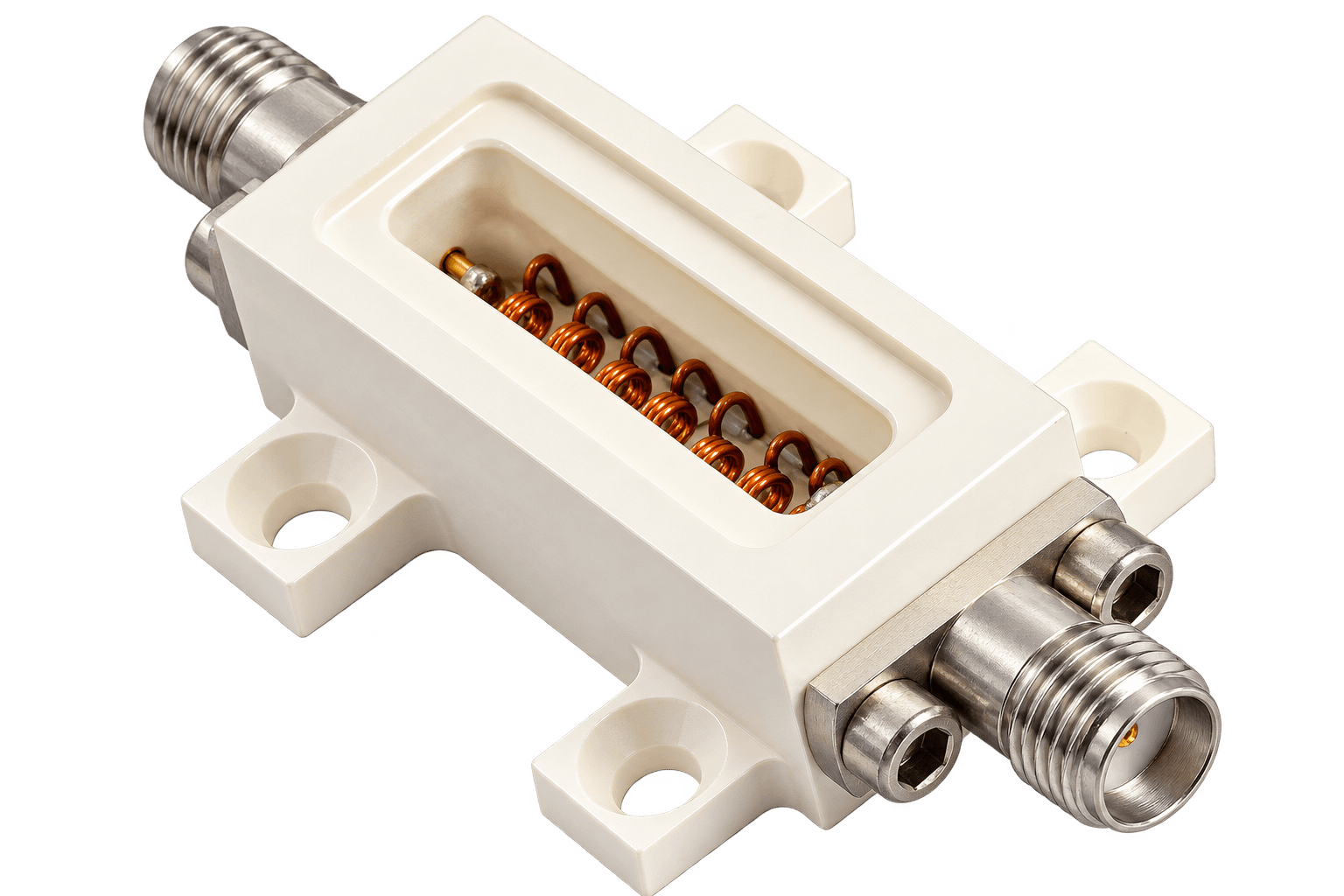
Spectrum Control's highpass filter advantages
 Wide variety of highpass filter topologies: lumped, cavity, SAW, ceramic, and glass.
Creative layouts minimize highpass filter footprint.
Integral shielding improves isolation.
Strategic pole and transmission-zero placement maximizes low-frequency rejection.
Topology blending maximizes rejection while minimizing passband loss.
Highpass cavity filters can be machined from lightweight alloys to reduce weight.
Key Performance
|
Feature
|
Specification |
|
Frequency
|
400 MHz to 40 GHz |
|
Size
|
As small as 3mm |
|
Temp Drift
|
Minimized spurious passbands |
|
Power Handling
|
1 ppm/°C |
|
Insertion Loss
|
As low as 0.1 dB |
How Highpass Filters Work
Lumped Element Highpass Designs
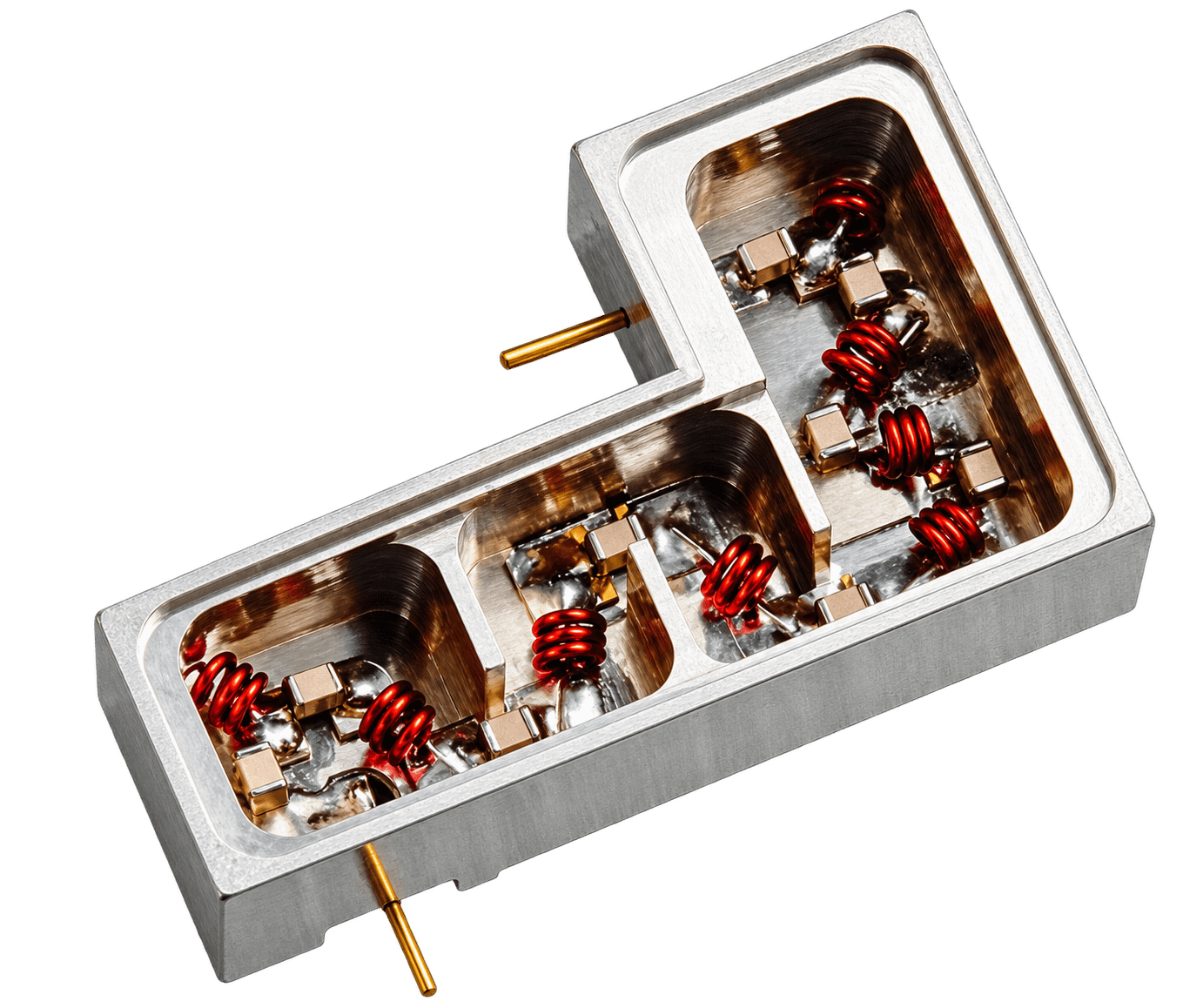
Built from carefully selected discrete inductors and capacitors, these lumped-element highpass filters operate from 1 kHz to 3 GHz. Component values and performance characteristics are optimized for the required cutoff frequency, low passband insertion loss, and strong rejection of unwanted lower-frequency signals. Because the components are much smaller than the operating wavelength, lumped-element designs provide a compact footprint and can be readily customized for specific electrical and packaging requirements.
SAW Designs
Spectrum Control's SAW highpass filters are optimized for low insertion loss above the cutoff frequency, a sharp transition band, and strong rejection of unwanted lower-frequency signals. Each unit is 100% tested and pre-aged at 100°C for stable, repeatable performance. Gold ball-bond wiring minimizes electrical loss, while silicon thermoset resin suppresses stray acoustic energy and supports consistent group delay.
Suspended Substrate Designs
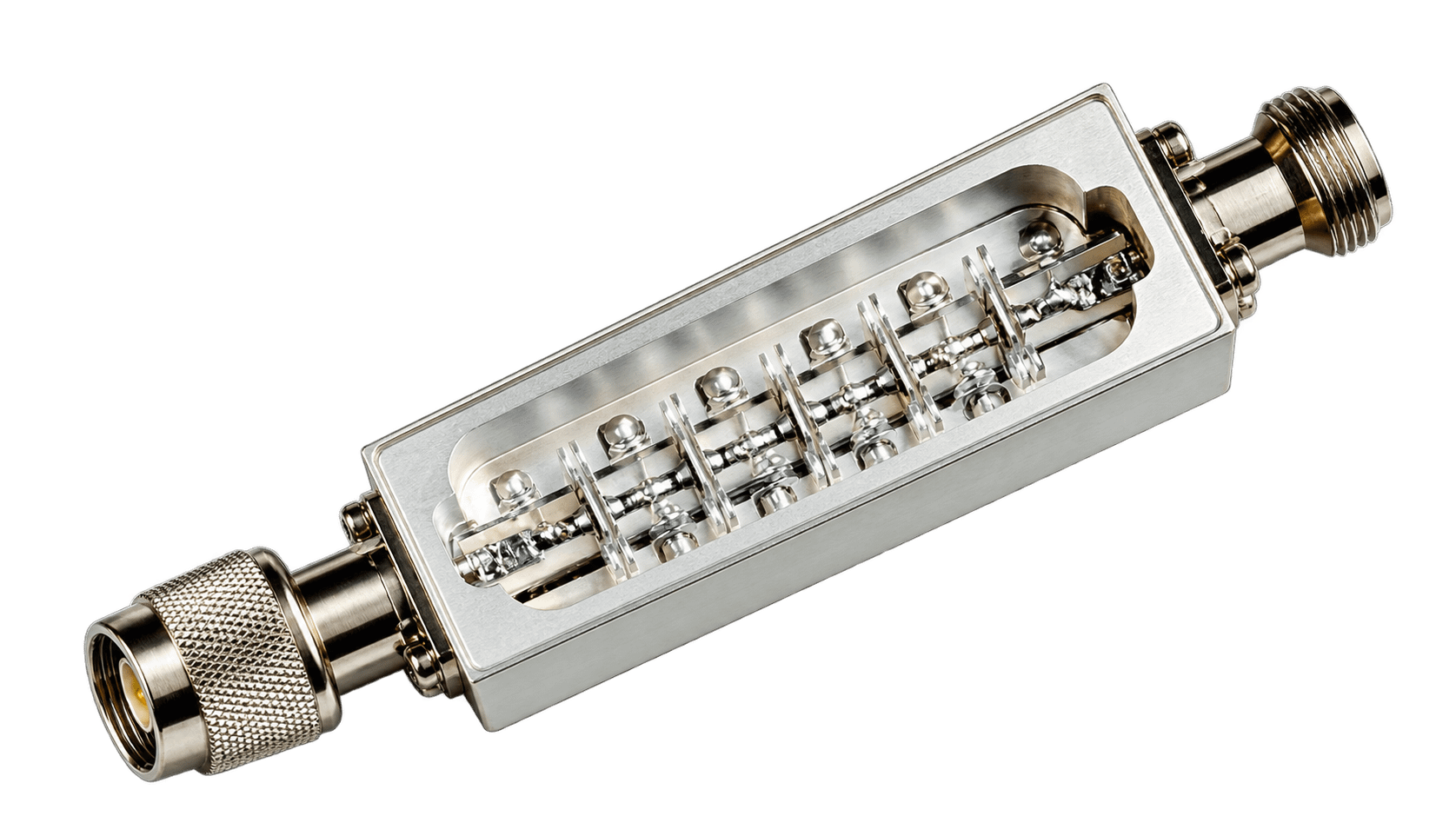
Spectrum Control's suspended-substrate highpass filters combine lumped and distributed elements within a single package to achieve complex responses that neither approach could provide alone. This mixed-topology construction maintains low passband insertion loss, while gold vias improve isolation between filter sections. A Cauer response with strategically placed transmission zeros sharpens the cutoff and strengthens rejection below the cutoff frequency without increasing package size. Integrated cleanup stages extend low-frequency suppression, creating a compact filter capable of meeting demanding specifications that might otherwise require multiple components.
Ceramic Designs
Spectrum Control's ceramic highpass filters use mixed-topology engineering to achieve low passband insertion loss, a sharp cutoff, and strong low-frequency rejection without a premium price. Ceramic elements as small as 2 mm maintain a compact footprint, while optimized coupling structures improve reliability and repeatability. Gold-plated, RoHS-compliant SMT packaging, with in-house laser sealing available, provides excellent solderability, corrosion resistance, and long-term consistency.
Cavity Highpass Designs
Spectrum Control's cavity highpass filters use precisely selected cavity dimensions and silver-plated internal surfaces to optimize cutoff frequency, insertion loss, and low-frequency rejection. Silver plating minimizes conductor resistance, helping achieve insertion loss as low as 0.1 dB while reducing heat generation. Their larger conductive surfaces and air-dielectric construction minimize dielectric heating and support exceptionally high RF power levels beyond those practical for smaller lumped-element designs.
Glass RF Filters
Spectrum Control's ultra-miniature glass highpass filters deliver high-Q performance in one of the smallest packages available, with operation up to 10 GHz and insertion loss below 2 dB in many designs. Their high-Q construction provides up to 70 dB of stopband rejection, effectively suppressing unwanted low-frequency signals below the cutoff. Passband group delay remains stable, as tight as 1 ns across temperature, making these filters ideal for phase-sensitive applications. Each design handles up to 1 watt of input power and can be customized for specific cutoff frequency, rejection, or packaging requirements.
How Highpass Filter Topologies Compare
|
Cavity: Distributed-element construction provides exceptionally low insertion loss and high power handling, making cavity highpass filters ideal for demanding high-power applications, although they require a larger package. |
|
Lumped Element: Discrete inductors and capacitors provide a compact, economical solution from 1 kHz to 3 GHz, with excellent flexibility for customizing cutoff frequency and low-frequency rejection. |
|
Ceramic: Compact ceramic elements provide a practical balance of size, electrical performance, and cost at frequencies up to 6 GHz. |
|
SAW: Piezoelectric substrates and interdigital transducers provide a sharp cutoff and strong low-frequency rejection in a small package, typically at frequencies up to approximately 1.6 GHz. |
|
3D Glass: High-Q glass-substrate integration provides low insertion loss, precise cutoff characteristics, and strong stopband rejection below the cutoff in an ultra-miniature package for applications up to 10 GHz. |
Applications
Defense and Radar Systems
- Rejects low-frequency interference, DC, and subharmonics
- Low passband insertion loss
- Stable under thermal cycling and vibration
High Power Wireless Infrastructure
- Suppresses low-frequency spurs in base stations and repeaters
- High power handling with low passband loss
- Strong rejection below the cutoff frequency
Available Across Filter Functions
Highpass filtering is available across Spectrum Control's portfolio of frequency-selective components, providing a range of technologies to meet different frequency, power, rejection, and packaging requirements:
- Cavity Filters - High-power highpass solutions that provide low insertion loss, sharp cutoff characteristics, and strong low-frequency rejection.
- Notch Filters - Suppress a specific interfering frequency while leaving the surrounding passband largely unaffected.
- Diplexers - Use lowpass and highpass filter paths to split or combine two frequency bands within one compact assembly.
- Triplexers - Combine three filtered paths while maintaining low insertion loss and high isolation between bands.
-
Multiplexers - Integrate multiple lowpass, highpass, or bandpass sections to channelize four or more frequency bands in complex systems.
Ready to specify a highpass filter for your application? Start with our Filter Customization Tool.