
PRODUCTS / COMPONENTS / FILTERS /
High Power SAW Filters
Spectrum Control is breaking new ground in SAW filter technology by introducing high-power (HP) input capabilities. These filters support input power levels up to +35 dBm CW at +125°C and cover narrowband, wideband, and fractional bandwidths across frequencies from 20 MHz to 1.6 GHz.
Our 20-500 MHz high-power SAW filters can handle up to +35 dBm CW input power at +125°C without degradation of key performance parameters, including center frequency, bandwidth, insertion loss, and ripple.
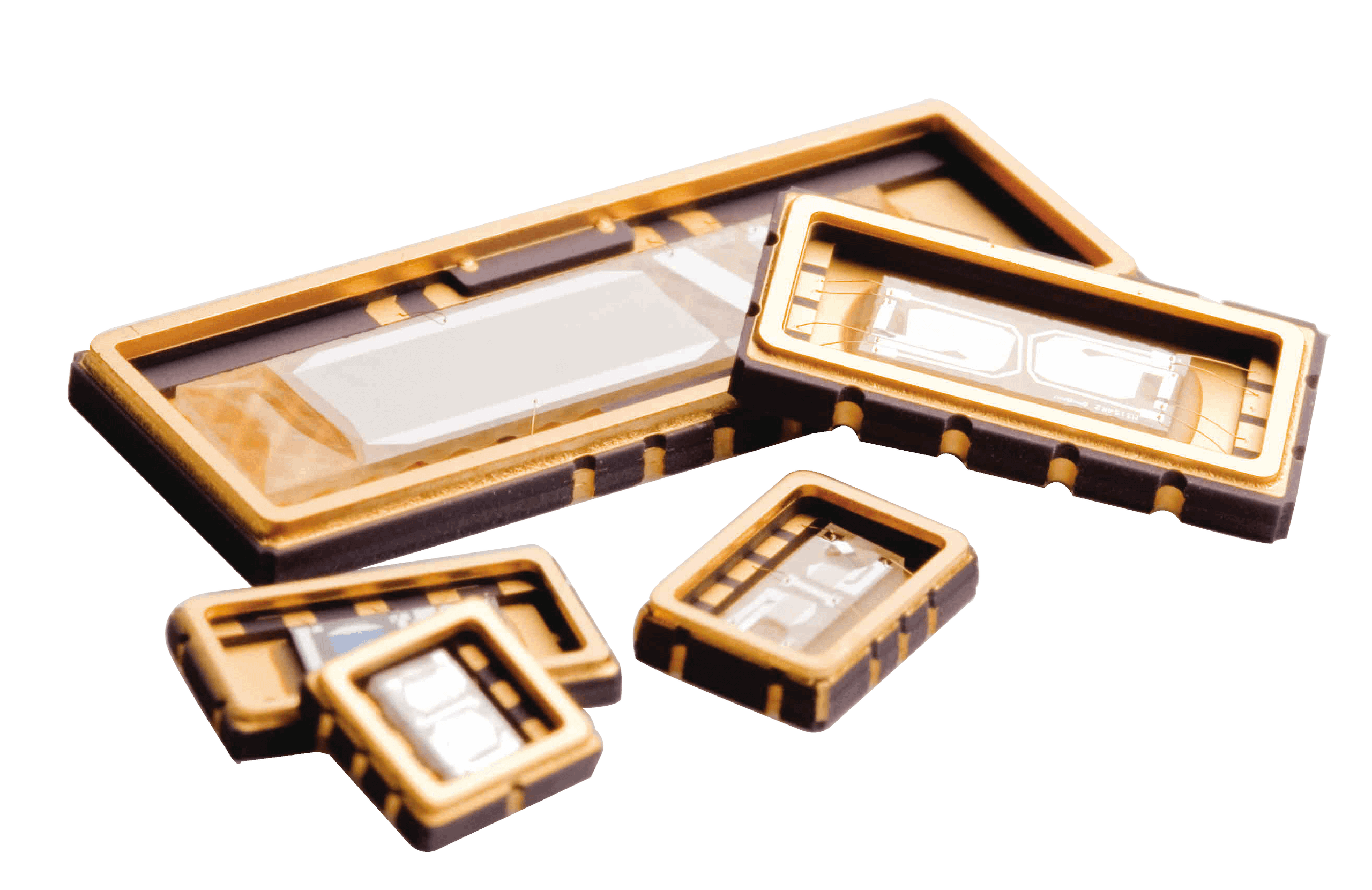
Spectrum Control’s high-power SAW filters are designed to support a wide range of demanding applications across military, aerospace, and commercial markets. These filters enhance signal selectivity and reliability in systems such as military radios and radar, critical infrastructure communications, smart grid networks, and GPS tracking. They are also well-suited for modern wireless and connectivity needs, including base stations, Wi-Fi, RFID, and automotive systems like keyless access, where maintaining clean and precise frequency performance is essential.
High Input Power SAW Filters
- Small size: Down to 3 x 3 mm LLC
- Durable: Pin = +15 to +35 dBm Steady State for >100 years equivalent
- Low insertion losses
- Temperature range of -40°C to 85°C
One advantage of high-power SAW filter technology is the ability to realize components with reduced size and weight at a lower cost than comparable filter technologies, since the same process equipment used by IC manufacturers can be adapted to produce SAW devices.
The figure to the right illustrates SAW filter power input handling capabilities versus center frequency. Input power is linear, with larger die sizes at lower frequencies and, conversely, smaller die sizes at higher frequencies.
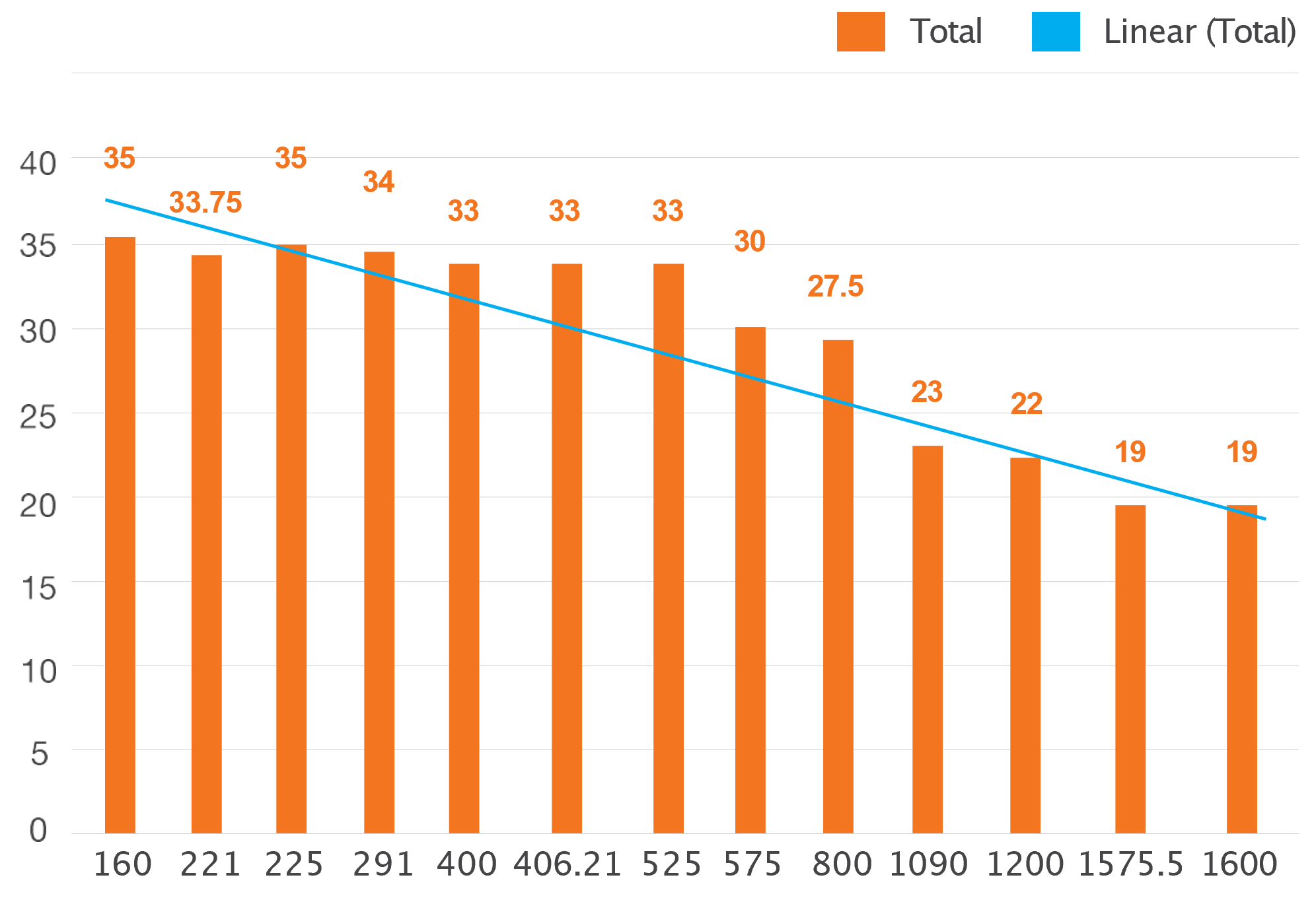 Input Power vs. Frequency
SELECT A TAB FOR MORE DETAILS
Spectrum Control offers a comprehensive line of high-power SAW filters designed for applications where reliability is critical. These filters provide excellent out-of-band rejection while maintaining high power handling and stable performance across demanding operating conditions.
The parts in the table below are currently in stock and available on evaluation boards. Need something custom? Contact us to discuss your requirements.
| Model Number | Center Frequency (MHz) | Bandwidth (MHz) | Rejection (dB) | Insertion Loss (dB) | Package | Power (dBm) | Datasheet |
| SF0291HP03540S | 291.4 | 1 | 48 | 3.1 | Ceramic LCC | 34 |  |
| SF0404HP03526S | 404 | 12 | 37 | 4 | Ceramic LCC | 30 | |
| SF0525HP03525S | 525 | 10 | 38 | 2 | Ceramic LCC | 34 | |
| SF0575HP03515S | 575 | 10 | 33.6 | 2.25 | Ceramic LCC | 32 | |
| SF0802HP03520S | 802.5 | 7 | 47.2 | 2.12 | Ceramic LCC | 33 | |
| SF1285HP13526S | 1285 | 10 | 40 | 4.7 | Ceramic LCC | 24 | |
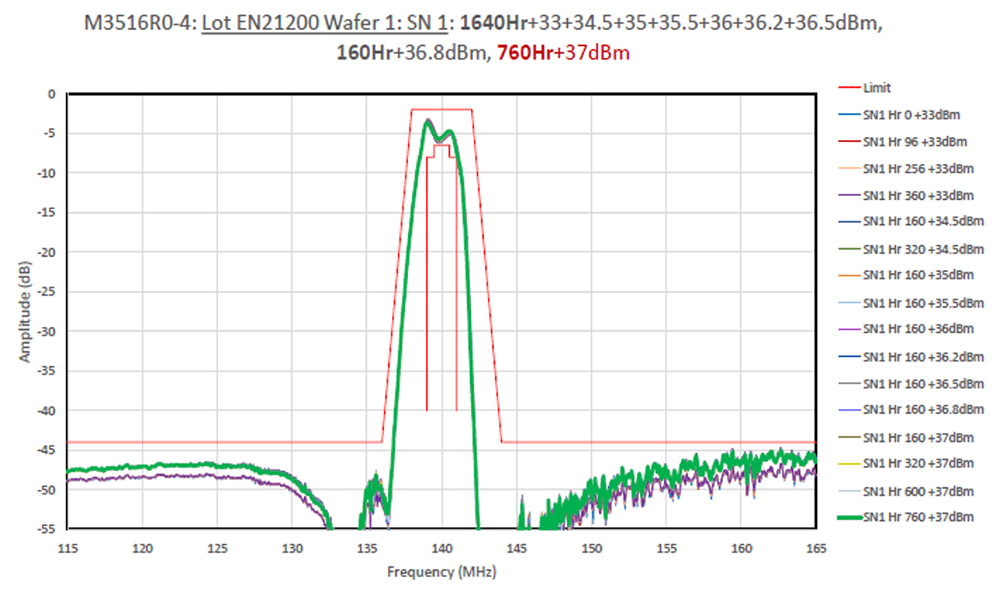
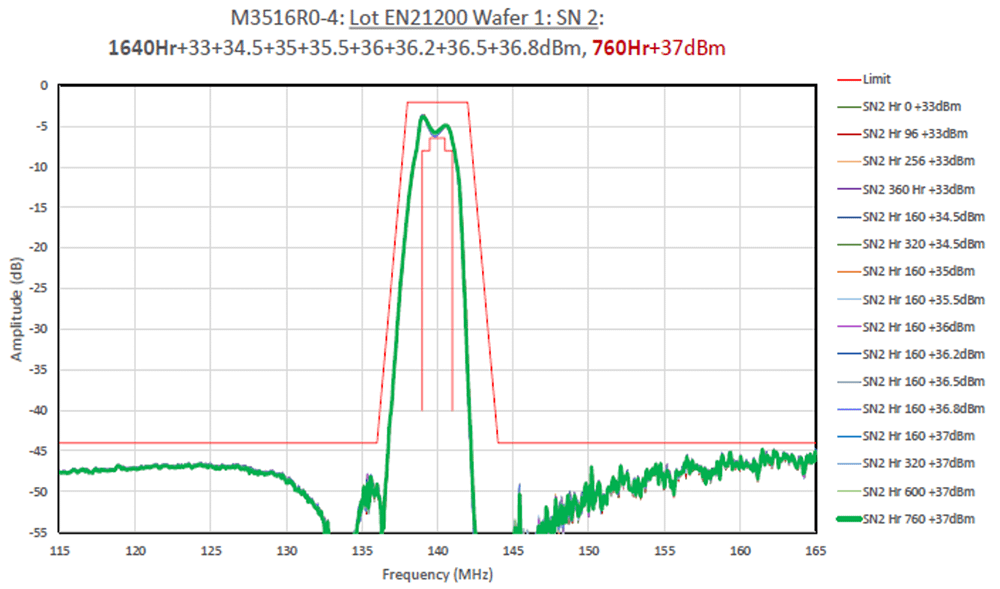
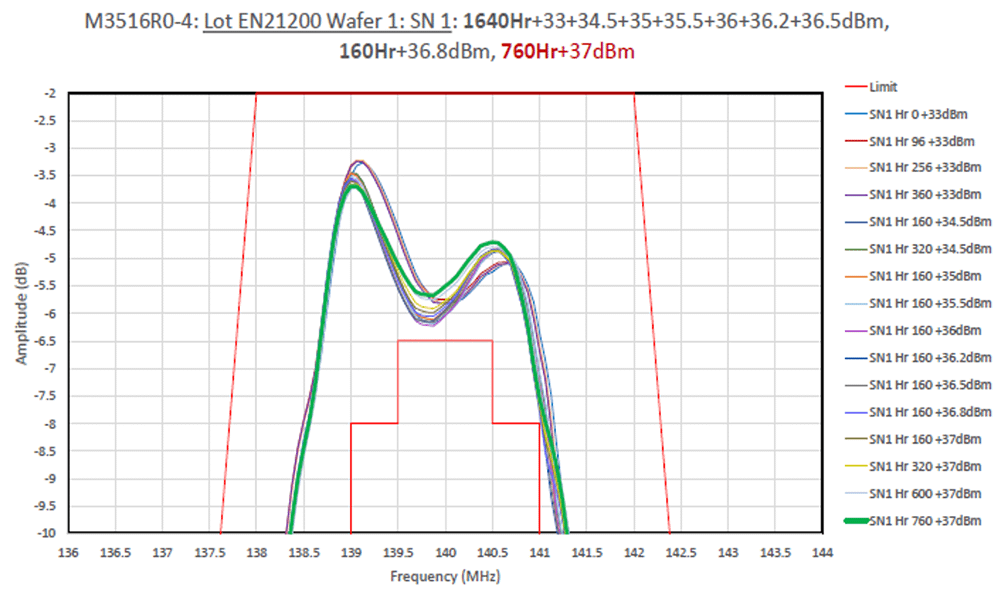
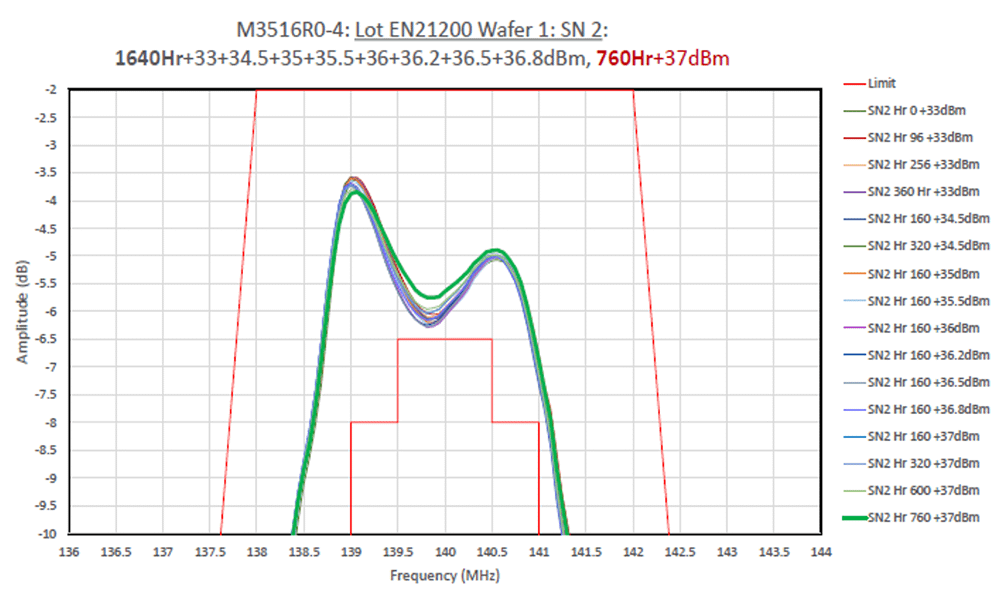
The data below demonstrates the high-power durability of Spectrum Control’s SAW filters under extended stress conditions. Two samples were initially tested at +33 dBm, with input power gradually increased to +37 dBm, as shown in the plots. Both devices successfully operated for 760 hours at +37 dBm (5 watts) at an elevated temperature of +125°C, maintaining stable performance throughout the test period.
Advanced SAW Filters
Spectrum Control continues to deliver advanced SAW technology for today’s military and commercial markets. These SAW filters, operating at frequencies up to 1600 MHz, offer a range of outstanding features, including:
- Low insertion loss below 2 dB
- Shape factors below 1.1:1
- Fractional bandwidths up to 60%
- 100% tested
- Pre-aged at 100°C
- Gold wire bonds used on all ball bonds to reduce loss
- Silicon thermoset resin to dampen stray acoustic energy and reduce distortion
- Superior group delay performance, as low as 8 ns unit-to-unit
Radar Applications for SAW Products
Another branch of SAW technology, particularly for radar applications, uses filters that deliver a linear change in delay across a defined passband. When paired with digital signal processing, SAW-based systems can track targets very effectively, using dispersive SAW delay lines and filters in both the transmitter and receiver to perform pulse compression and expansion. Spectrum Control SAW filters feature extremely steep skirts to isolate signals of interest in crowded or contested spectrum, and defense-grade designs are engineered to withstand shock, vibration, and temperature fluctuations. Low-loss SAW filters also provide ultra-flat group delay, which helps preserve the precise timing required for advanced missile guidance platforms.
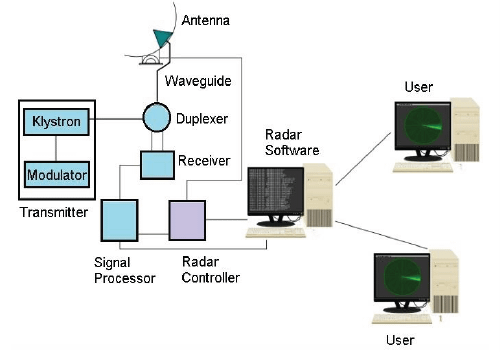
Block diagram for a typical radar system for target detection.
Pulse-compression radar uses dispersive (chirp) filters in both the transmit and receive sections to expand the transmitted waveform and compress the received return, enabling shorter-duration, lower-peak-power transmissions while maintaining sensitivity through improved signal-to-noise ratio. In modern radar applications such as AESA (active electronically scanned array), the antenna electronically steers radio waves without moving the antenna, with each element connected to a compact computer-controlled module that performs both transmit and receive functions.
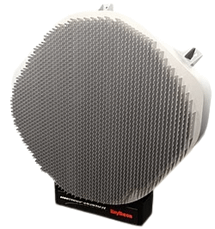
AESA radars can transmit multiple RF beams at multiple frequencies simultaneously and spread emissions across a wider spectrum, making them harder to detect over background noise while still enabling high-performance operation for ships and aircraft. SAW filters also provide bandpass filtering across many defense applications, including IF filtering in superheterodyne receivers, IF filtering within software-defined radios (SDRs), and IFF, where low-loss designs can deliver high selectivity and low distortion in a smaller, lower-cost form factor than alternative technologies. In superheterodyne receivers, SAW filters are often used as the RF and IF bandpass filters to suppress transmission leakage and interference at RF, and to provide highly selective channel filtering at IF.
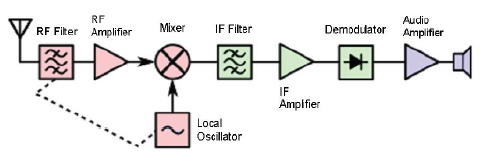
Block diagram of a superheterodyne receiver.
Spectrum Control low-loss SAW filters are also used in transceiver systems and are commonly employed in duplexers within transmit/receive designs.
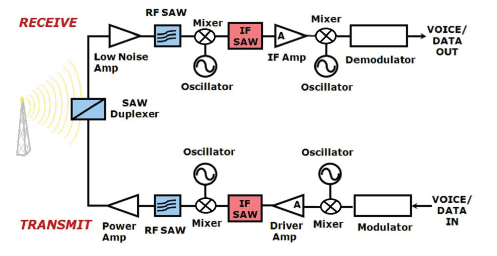
Block diagram of a generic transceiver circuit.
SAW v. Alternative Filtering Techniques
High-power SAW filters provide a more effective and practical solution for mitigating interference compared to traditional approaches engineers have relied on in the past. Alternatives such as bulk acoustic wave (BAW) filters, hybrid filters, and lumped-element designs each come with inherent limitations.
- BAW Filters: A common alternative, BAW filters are well suited for frequencies above 1.4 GHz. At lower frequencies, however, their performance degrades, limiting their range of applications. In addition, BAW devices handle power less efficiently because the acoustic wave propagates through the bulk of the substrate, requiring stacked metallized structures and layers. By contrast, SAW filters guide the acoustic wave along the surface of the substrate, enabling more efficient operation.
- Hybrid Filters: A hybrid approach combines passive and active filtering elements. The passive filter manages low-order harmonic currents, while the active filter targets higher-order harmonics.
- Lumped Element Filters: These passive filters are constructed from discrete inductors (L), capacitors (C), and resistors (R) configured to meet specific design requirements.
All of these approaches share a key drawback, they are significantly larger than SAW filters, often requiring 3x to 10x more PCB space. In contrast, SAW filters are more compact, lighter, and more cost-efficient than other filter technologies, making them a superior choice for modern designs.