PRODUCTS / COMPONENTS / FILTERS /

Bandpass Filters

Low insertion loss bandpass filters (0.1 dB) are essential for many of today’s defense platforms and modern wireless environments that require high spectral fidelity. Low insertion loss bandpass filters (0.1 dB) by Spectrum Control help receivers detect and process low-power targets, as well as discern targets of interest in interference-heavy environments. Spectrum Control offers 0.1 dB loss bandpass filters to help identify weak communication transmissions and recognize valuable intelligence signals in a crowded spectrum.

Visit Spectrum Control's Bandpass Filter Customization Tool today to optimize your demanding filter requirements.

Spectrum Control's database of low-loss bandpass filter designs (0.1 dB) helps eliminate the need for additional gain when Size, Weight, and Power (SWaP) initiatives are in place. Low-loss filters from Spectrum Control also help suppress harmonics at the receiver front end when complex pulse or chirp signals are cascaded in the receive-side chain. This is especially critical where a flat amplitude response helps prevent distortion and unwanted spurious modulation.

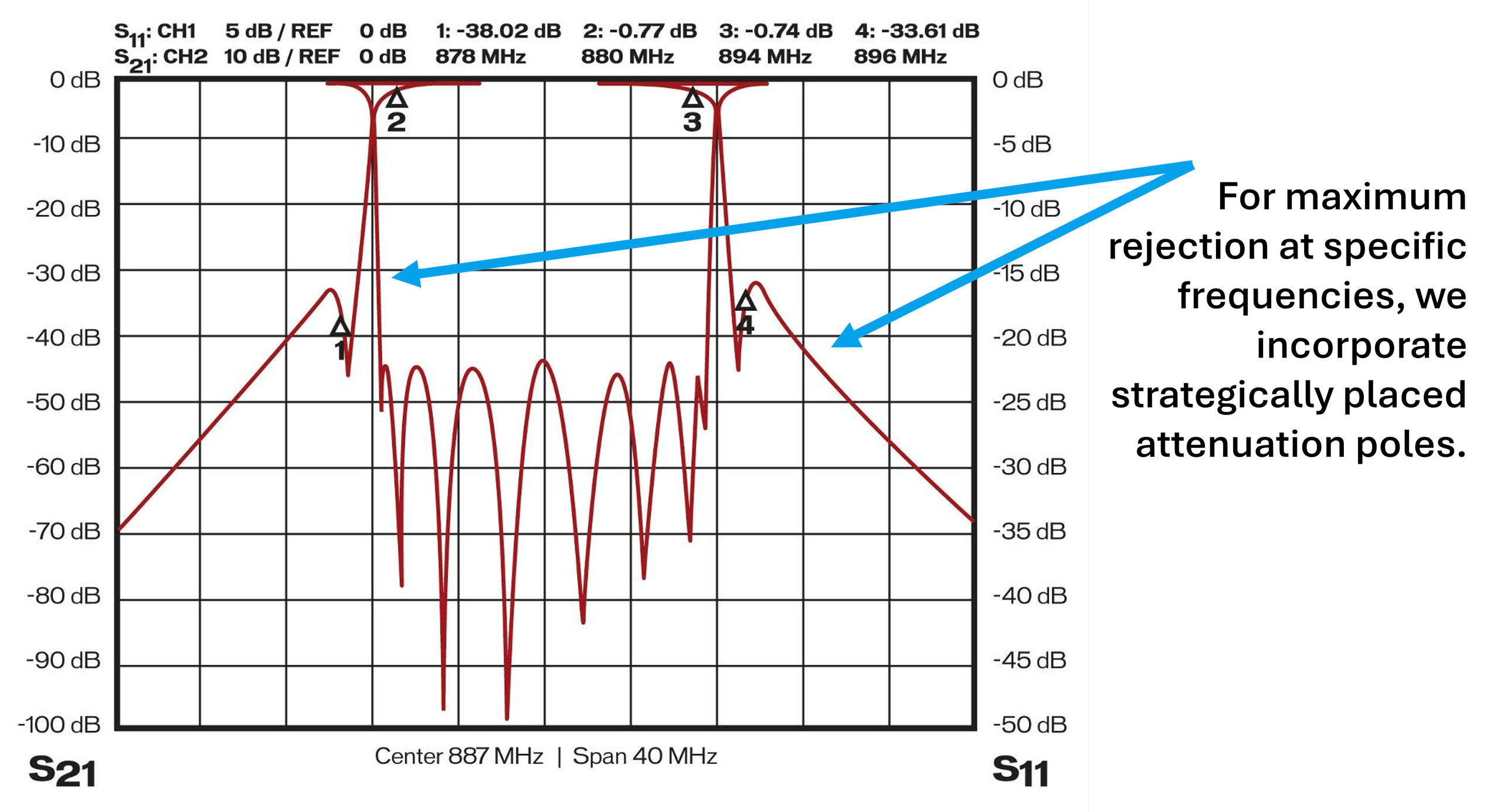
Spectrum Control’s line of low-loss bandpass filter designs (0.1 dB) delivers insertion loss as low as 0.1 dB while optimizing pole-placement strategies to achieve high rejection in a compact design. These low-loss bandpass filters (0.1 dB) also help maintain receiver sensitivity in crowded wireless spectra. High insertion loss can lead to excessive heat, requiring additional cooling strategies or heavier metal packaging to prevent thermal runaway.

Low-loss bandpass filters (0.1 dB) from Spectrum Control improve signal-to-noise ratio (SNR) performance by providing a lower-loss path for weak signals, maintaining spectral purity without harmful bit-error-rate (BER) degradation. Spectrum Control also offers a selection of Rapid Filter options, providing bandpass filters in both Chebyshev and Elliptic functions to meet critical demand requirements.
bandpass-graph.png

Bandpass filter frequency response

Lumped Element Filters

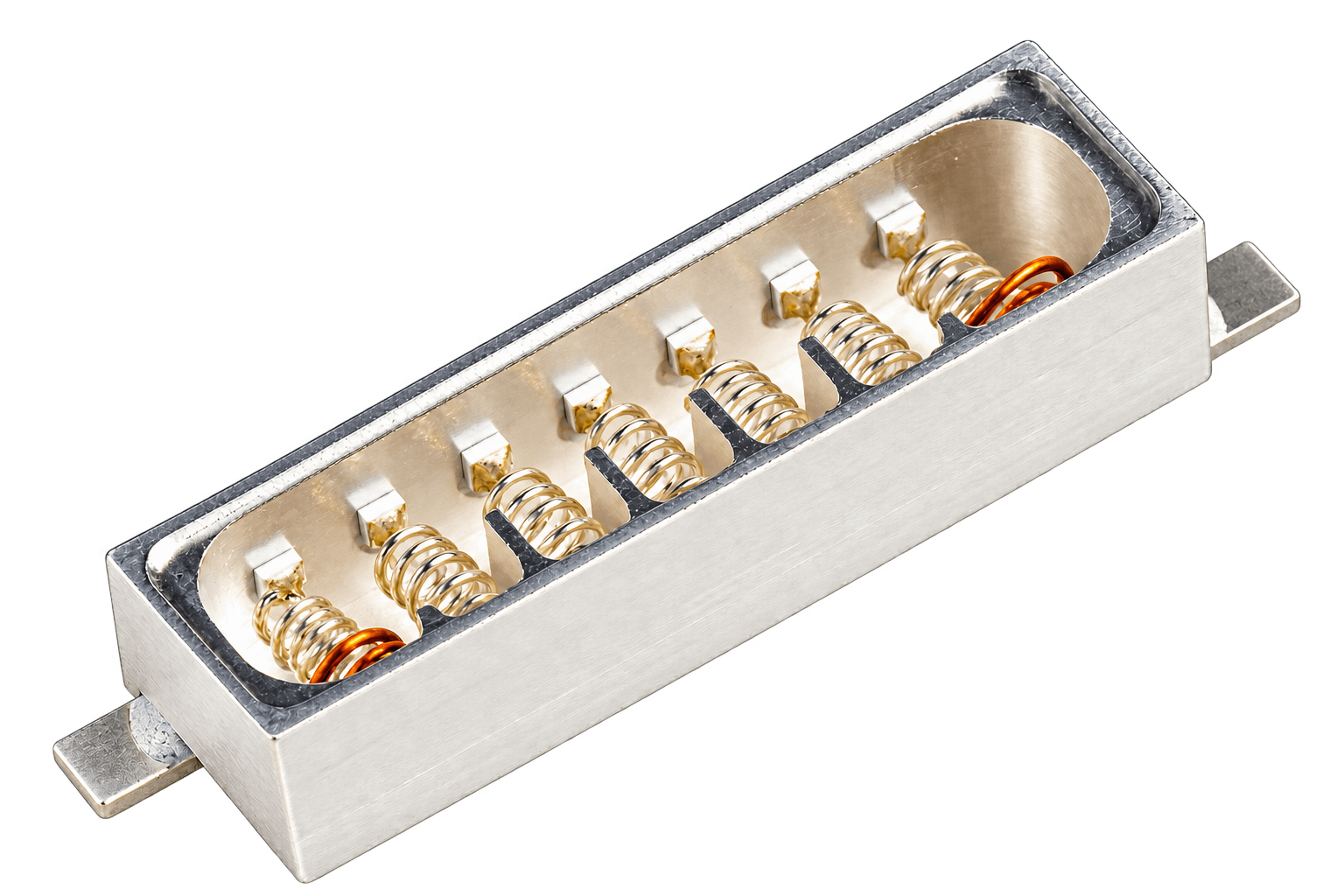
Spectrum Control’s superior low-loss (0.1 dB) lumped element designs are ideal for applications where size and weight are critical. Our filter engineers are experts in lumped element design techniques and employ a range of innovative methods to meet today’s demanding specifications.

  • Lightweight surface-mount packages for airborne applications
  • Silver plating to reduce insertion loss
  • Integral shielding for improved isolation
  • Strategically placed poles for maximum rejection
  • Multiple topologies integrated within a single package for broad frequency coverage

Lumped Element Filter.png


Spectrum Control’s lumped element filters are designed using discrete inductors and capacitors, covering HF, VHF, UHF, L-band, and portions of S-band (approximately 10 MHz to 3000 MHz). Below 1000 MHz, wavelengths are relatively long; distributed-element filters like cavity filters must be at least a fraction of the operating wavelength, which can make cavities physically larger than other topologies such as lumped elements.

Because discrete capacitors and inductors are much smaller than the operating wavelength, lumped element filters can achieve a smaller footprint than cavity designs.

Distributed-element filters, such as cavity filters, can exhibit spurious passbands, harmonic passbands, or a re-entrant response because their performance depends on the physical dimensions of the structure relative to the wavelength.

By contrast, Spectrum Control’s lumped element filters are smaller than the operating wavelength and therefore do not exhibit re-entrant modes or undesirable harmonic passbands, resulting in a cleaner response. They can also achieve very wide fractional bandwidths (roughly 10% to 90%), which can be difficult to replicate with narrow-band cavity-style topologies.

Lumped element filters are relatively easy to tune by adjusting poles using air-spaced inductive coils. Because these designs typically use standard, off-the-shelf discrete elements and don’t require complex specialized machining (unlike cavity filters), they generally offer lower cost and high customizability.

Finally, because the entire lumped element filter is much smaller than the wavelength it is designed to cover, there is minimal phase change between the input and output compared with distributed elements like cavity filters, where signal transit time is significantly longer.

Frequency 10 MHz to 3000 MHz check mark.png
Size Small check mark.png
Cost Low check mark.png
Harmonics No Spurious Passbands check mark.png
Power Handling Up to 100 Watts check mark.png

Lumped Element Filter-2.jpg

Lumped Element Filter.jpg

Cavity Filters

One of the advantages of selecting Spectrum Control’s cavity filter designs is their industry-leading low insertion loss performance (0.1 dB) combined with high power-handling capability (up to 400 watts). Spectrum Control engineers have researched the suppression of intermodulation products in low-loss (0.1 dB), high-power (400-watt) cavity designs and, through careful process control and component selection, have developed specialized design techniques to meet our customers’ demanding requirements.

check mark.png  
Machined from lightweight aluminum alloys to reduce weight
check mark.png  
Gold and silver plating using NADCAP-controlled processes
check mark.png  
Proprietary techniques to minimize temperature drift to less than 1 ppm/°C
check mark.png  
Spectrum Control’s pseudo-elliptic designs incorporate cross-coupling to create transmission zeros, resulting in enhanced close-in rejection performance without increased insertion loss
check mark.png  
Unique resonator designs that increase peak power-handling capability
check mark.png  
Silver plating on resonators and internal cavity surfaces to achieve higher Q compared to lower-cost plating methods
check mark.png  
Low dielectric constant stabilizing structures designed to withstand extreme shock and vibration environments


Pseudo-elliptic designs developed by our engineers reduce the number of poles required to meet specified rejection responses, resulting in smaller filters with lower insertion loss (0.1 dB) and reduced cost. Similar techniques can also be applied to provide passband group delay equalization or to increase rejection across a specified stopband region.

  Cavity-Filter.png


miniature bandpass cavity filter.png  

Spectrum Control Low Loss (0.1 dB) Bandpass Filters, known worldwide as innovators in the RF filter marketplace, offer innovative cavity filter topologies when performance cannot be compromised. Spectrum Control cavity filter advantages stem from their high-Q designs and creative strategies to reduce size and increase power-handling robustness.


Spectrum Control Low Loss (0.1 dB) Bandpass Filters, known worldwide as innovators in the RF filter marketplace, offer innovative cavity filter topologies when performance cannot be compromised. Spectrum Control cavity filter advantages stem from their high-Q designs and creative strategies to reduce size and increase power-handling robustness.

  interdigital bandpass filter.png


Bandpass filter.png  

Spectrum Control bandpass cavity filters offer ultra-low insertion loss (0.1 dB) because they have very low internal resistance, due in part to plating that is often silver. This means Spectrum Control cavity filter designs are more efficient and better able to handle radiated signal power. Spectrum Control cavity filters can handle thousands of watts; their larger physical surface area compared with lumped element filters, along with the use of air dielectrics, helps prevent arcing that could destroy a traditional lumped element filter.


Frequency
10 MHz to 3000 MHz
check mark.png
Size
Small
check mark.png
Cost
Low
check mark.png
Harmonics
No Spurious Passbands
check mark.png
Power Handling
Up to 100 Watts
check mark.png


Pole placed bandpass filter-graph.png

Spectrum Control cavity filters, with their high unloaded-Q designs, can achieve incredibly narrow fractional bandwidths with very steep skirts. This allows Spectrum Control cavity filters to pass a narrow band while heavily attenuating tones just a few MHz away from the band edge. Spectrum Control bandpass filters in a cavity topology are often designed from Invar, which offers a very low coefficient of thermal expansion. This helps ensure Spectrum’s frequency response doesn’t drift as ambient temperatures change, unlike some other manufacturers’ designs.


With a Spectrum Control bandpass filter in a cavity topology, the solid metal housing acts like a Faraday cage, preventing EMI from leaking out and external noise from another channel from leaking in. Known for unparalleled attenuation levels, Spectrum Control cavity filters can provide massive attenuation (100+ dB), which is normally difficult to achieve due to parasitic coupling. Unlike some other filter manufacturers, Spectrum Control offers unique resonator designs, like the one pictured here, to reduce overall size and increase peak power handling.

  bandpass-filter-2-arrows.png


cavity-filter.png  

Spectrum Control bandpass filters use unique design approaches to reduce unit size, one of which is iris coupling. Iris coupling transfers electromagnetic energy between adjacent cavities through precisely shaped apertures in the cavity walls. These apertures behave as reactive shunt inductances or capacitances, increasing coupling between resonators and shaping the overall filter response.


Spectrum’s pseudo-elliptic designs incorporate cross-coupling to create transmission zeros, resulting in enhanced rejection performance. Unlike Chebyshev or Butterworth designs, where rejection increases gradually as you move farther from the center frequency, Spectrum Control pseudo-elliptic filters use cross-coupling to force the signal to zero at specific nearby frequencies, creating a steeper skirt between the passband and the stopband.

  bandpass-cavity-filter-arrows.png


bandpass-filter-arrows.png  

Spectrum Control bandpass filters can incorporate a unique low-dielectric-constant stabilizing structure to reduce overall sensitivity to shock and vibration. Even microscopic shifts in resonator positions can induce microphonics or frequency modulation. If a support structure like the one shown to the left had a higher dielectric constant, even a small movement caused by heating could produce a significant shift in center frequency. These innovative structures from Spectrum Control mitigate shifting effects through three primary mechanisms: they reduce electromagnetic disruptions, add mechanical damping and stiffness, and use low-dielectric materials to reduce mass and weight, making them less likely to shift.


Spectrum engineers routinely use an integrated cleanup low-pass filter to provide extended stopband performance. An integrated cleanup low-pass filter is a complementary filtering stage whose primary role is to suppress multiple harmonic resonances and spurious tones in resonant cavity structures. Without a cleanup low-pass stage, a transmitter could leak high-power harmonics that may interfere with out-of-band receivers.

  Band-pass filter.jpg


Bandpass filter.png  

Tightly controlled conductor spacing and surface finish yield very high power-handling capability. Spectrum Control bandpass filters utilize tightly controlled conductor spacing. Cavity filters are naturally high-Q filters; by design, they store significant electromagnetic energy within their resonators or sections. The space, or distance, between the resonator and the interior cavity walls is critical to optimizing power-handling capability.


Using silver plating on our resonators and cavity interiors reduces loss and provides higher Q values than the less expensive plating methods used by other filter manufacturers. Due to its atomic structure, silver has the highest electrical conductivity of any metal. In high-Q Spectrum Control cavity filters, Q is partly defined by the ratio of stored energy to dissipated energy. Using a more conductive finish such as silver directly reduces the amount of energy lost as heat, resulting in higher Q and lower insertion loss.

  band-pass cavity filter.png


Bandpass Cavity filter.png  

Spectrum Control bandpass filters use innovative cross-coupling techniques to achieve optimal rejection by introducing electromagnetic energy between non-adjacent resonators, creating signal paths that cancel at specific frequencies. Spectrum Control also incorporates bimetallic resonators to improve temperature stability, minimizing frequency drift caused by thermal changes that can alter cavity dimensions and shift the center frequency across the band.


Advanced SAW Filters

Spectrum Control continues to deliver advanced SAW technology for today’s military and commercial markets. These SAW filters, operating at frequencies up to 1600 MHz, offer a range of outstanding features, including:

  • Low insertion loss below 2 dB
  • Shape factors below 1.1:1
  • Fractional bandwidths up to 60%
  • 100% tested
  • Pre-aged at 100°C
  • Gold wire bonds used on all ball bonds to reduce loss
  • Silicon thermoset resin to dampen stray acoustic energy and reduce distortion
  • Superior group delay performance, as low as 8 ns unit-to-unit

SAWFilters.jpg

Radar Applications for SAW Products

Another branch of SAW technology, particularly for radar applications, uses filters that deliver a linear change in delay across a defined passband. When paired with digital signal processing, SAW-based systems can track targets very effectively, using dispersive SAW delay lines and filters in both the transmitter and receiver to perform pulse compression and expansion. Spectrum Control SAW filters feature extremely steep skirts to isolate signals of interest in crowded or contested spectrum, and defense-grade designs are engineered to withstand shock, vibration, and temperature fluctuations. Low-loss SAW filters also provide ultra-flat group delay, which helps preserve the precise timing required for advanced missile guidance platforms.

SAW-Radar-Block-Diagram.png

Block diagram for a typical radar system for target detection.

Pulse-compression radar uses dispersive (chirp) filters in both the transmit and receive sections to expand the transmitted waveform and compress the received return, enabling shorter-duration, lower-peak-power transmissions while maintaining sensitivity through improved signal-to-noise ratio. In modern radar applications such as AESA (active electronically scanned array), the antenna electronically steers radio waves without moving the antenna, with each element connected to a compact computer-controlled module that performs both transmit and receive functions.

AESA-Radar.png

AESA radars can transmit multiple RF beams at multiple frequencies simultaneously and spread emissions across a wider spectrum, making them harder to detect over background noise while still enabling high-performance operation for ships and aircraft. SAW filters also provide bandpass filtering across many defense applications, including IF filtering in superheterodyne receivers, IF filtering within software-defined radios (SDRs), and IFF, where low-loss designs can deliver high selectivity and low distortion in a smaller, lower-cost form factor than alternative technologies. In superheterodyne receivers, SAW filters are often used as the RF and IF bandpass filters to suppress transmission leakage and interference at RF, and to provide highly selective channel filtering at IF.

SAW-superheterodyne-Block-Diagram.png

Block diagram of a superheterodyne receiver.

Spectrum Control low-loss SAW filters are also used in transceiver systems and are commonly employed in duplexers within transmit/receive designs.

SAW-Transceiver-Block-Diagram.png

Block diagram of a generic transceiver circuit.

​​​​​​​

Ceramic Filters

Spectrum Control designers are experts in the application of multiple filter topologies, including creative mixed-topology approaches that can be integrated into a single design. High-complexity ceramic filters—such as a six-pole, 2100 MHz design with a 45/0.5 dB shape factor of less than 3:1—demonstrate exceptional performance while delivering strong value.

  • Gold-plated surface-mount packages improve solderability and corrosion resistance
  • Alternative coupling structures offer superior performance
  • Capacitive coupling arrays provide enhanced reliability and repeatability
  • Ceramic resonator designs as small as 2 mm reduce overall filter footprint
  • Lead-free solders are used to comply with strict RoHS standards
  • Select designs are laser-sealed using Spectrum Control’s in-house sealing methodologies


CeramicFilter.jpg   CeramicFilter-single.jpg


3D Glass SMT Filter

Spectrum Control continues to advance filter technology with the release of its new ultra-miniature glass filters. These high-Q filters, operating at frequencies up to 10 GHz, offer a range of outstanding features, including:

  • Low insertion loss below 2 dB in many designs
  • Rejection levels up to 70 dB
  • Group delay of 1 ns across temperature
  • Input power handling up to 1 watt
  • Customization to meet demanding requirements


High_Q_filter_update.jpg

Suspended Substrate Filters

Spectrum’s low-loss suspended substrate filters enable complex transfer functions by integrating multiple filter topologies within a single package. Spectrum Control’s expert engineers optimize low-loss suspended substrate designs to meet demanding performance requirements. Suspended substrate features include:

  • Expertise in combining lumped and distributed elements within a single suspended substrate design, providing enhanced unloaded Q and exceptionally low insertion loss
  • Gold vias for superior isolation
  • Cauer pole–placed transfer functions that yield low insertion loss performance
  • Integrated cleanup low-pass filters for improved broadband performance


Suspended Substrate Filter.jpg